

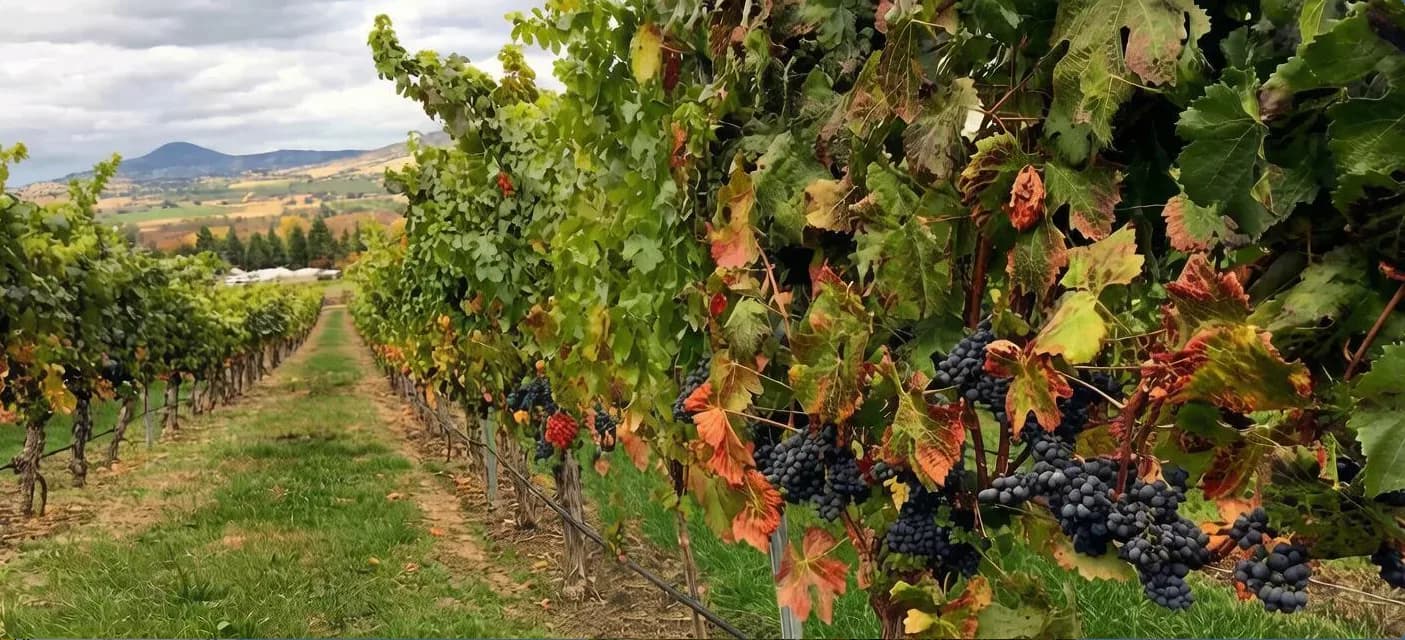
Vineyard water stress: the physiology of water deficit and transpiration management as a tool for preserving productivity and quality
Amid global climate change — marked by rising average temperatures and increasingly erratic rainfall — water stress has become one of the main limiting factors in viticulture. Periods of soil and atmospheric drought, extreme heat and hot dry winds are not merely temporary inconveniences for the grapevine: they are a powerful abiotic stressor capable of disrupting physiological processes, cutting yield and permanently degrading berry quality within a short time. Understanding how water stress develops — and, more importantly, how to manage the vine's water relations — has become essential for the modern grower.
Hydrostress: From Water Deficit to a Cascade of Physiological Disorders
The grapevine (Vitis vinifera L.) is historically adapted to relatively arid conditions; however, this does not imply immunity against acute and prolonged water deficit. Hydrostress triggers a complex cascade of physiological reactions, the key trigger mechanism of which is the disruption of water balance.
The first and most rapid response of the plant to an incipient moisture deficit is stomatal closure. Stomata are microscopic pores on the leaf surface through which gas exchange occurs: absorption of carbon dioxide (CO2\text{CO}_2CO2) for photosynthesis and release of oxygen, as well as — what is critical in the context of water regime — evaporation of water, or transpiration. Stomatal closure is a protective mechanism aimed at preventing catastrophic water loss and tissue dehydration. However, this defense carries a high physiological cost.
Closed stomata sharply limit CO2\text{CO}_2CO2 influx into the leaf. As a result, photosynthetic intensity drops, which is confirmed by numerous studies: grape plants experiencing water stress exhibit a significant decrease in CO2\text{CO}_2CO2 assimilation rate and stomatal conductance compared to adequately irrigated plants. A decline in photosynthetic activity directly leads to a deficit of assimilates (sugars and other organic compounds) necessary for shoot growth, formation, and berry filling.
Chronic hydrostress is exacerbated by xylem cavitation — the formation of air bubbles (embolism) in the conducting vessels of the xylem. These bubbles block the upward flow of water from roots to leaves, akin to a thrombus in a blood vessel. Different grape varieties demonstrate varying resistance to cavitation, which is linked to anatomical features of xylem structure and the activity of aquaporin genes (water channels in cell membranes). Nevertheless, upon reaching a certain threshold of leaf water potential (ΨL\Psi_LΨL), cavitation becomes inevitable, aggravating water deficit even when soil moisture is present.
The cumulative impact of hydrostress on a vineyard manifests in the following negative consequences:
Slowdown and cessation of shoot growth. Water deficiency inhibits cell division and expansion, leading to weakened bush vigor and reduced potential for future fruiting.
Yield reduction. Stress experienced during the critical pre-flowering period or during berry set can lead to flower drop, smaller berry size, and consequently, direct crop shortage.
Grape quality impairment. The influence of water stress on quality is ambiguous and heavily dependent on the phenological phase and intensity. Moderate stress after veraison onset may stimulate sugar and phenolic compound accumulation (anthocyanins, tannins) in the skin, improving color and potential for high-quality red wine production. However, severe or prolonged stress, especially in hot climates, produces the opposite effect: excessive sugar accumulation with insufficient phenolic maturity, creating imbalance in the wine (high alcohol with deficient structure and color) and lowering acidity. Under extreme heat, sugar content may even decline due to general photosynthesis suppression.
Transpiration as a Control Point: From Inevitable Evil to a Regulated Process
Traditionally, transpiration is often perceived as an "inevitable evil" — a process that must be maximally suppressed under arid conditions. Such an approach, however, is oversimplified and can cause harm. Transpiration serves not only as a water pump function but also acts as the primary thermoregulation mechanism for the plant. By evaporating water, the leaf cools itself, preventing overheating and thermal damage to the photosynthetic apparatus.
A modern strategy for managing water stress lies not in completely blocking transpiration, but in its optimization and regulation, particularly during critical periods. This specific task is addressed by the application of next-generation specialized anti-transpirant preparations, such as Foliart Iliostop.
Foliart Iliostop: Fine-tuning of Water Balance
Foliart Iliostop is a transpiration regulator acting via the formation of a thin, semi-permeable polymeric film on the leaf surface. Unlike rigid film-formers that can fully block gas exchange, Iliostop operates on the principle of a "smart valve."
Its composition, including organic polymers and viscosity modifiers, pectin, and a pro-hormonal complex, ensures multi-level action. The film restricts excessive water loss, creating additional diffusion resistance for water vapor. However, it remains permeable to CO2\text{CO}_2CO2 and O2\text{O}_2O2, allowing photosynthesis to continue. Research indicates that reducing water losses through transpiration during phases of water stress leads to increased photosynthetic activity and crop productivity.
The key advantage of Iliostop in the context of viticulture lies in its ability to prevent sharp fluctuations in plant water status. During hot midday hours, when transpiration intensity peaks while the root system cannot supply water fast enough, Foliart Iliostop prevents critical drops in leaf water potential and cavitation development. During morning and evening hours, when conditions are milder, gas exchange restores almost to full capacity.
Application of Foliart Iliostop to vineyards is recommended to be carried out preventively, before the forecasted dry spell or extreme heat arrives, or at the first signs of water stress.
It is important to note that Foliart Iliostop does not replace irrigation but serves as a tool for its rationalization. It allows increasing the efficiency of water use by the plant, reducing irrigation rates without compromising yield and quality, as well as protecting the vineyard under conditions where irrigation is technically impossible or restricted.
Conclusion
Hydrostress is a comprehensive physiological trial for the grapevine, affecting all aspects of its vital activity. In the arsenal of the modern vigneron, alongside selecting resistant rootstocks and optimizing soil water regime, transpiration regulators hold an important place. The application of Iliostop preparation allows shifting water balance management from the level of "reacting to stress" to the level of "prevention and fine-tuning," which ultimately ensures stable vineyard productivity and high harvest quality even amidst growing climate aridization.
#Foliart #Viticulture #Hydrostress #Vineyards #PlantProtection #AntiTranspirant #Iliostop #StressManagement #GrapeQuality #Transpiration #DroughtResistance #Agrotechnics #Winemaking #PlantPhysiology #Foliart