





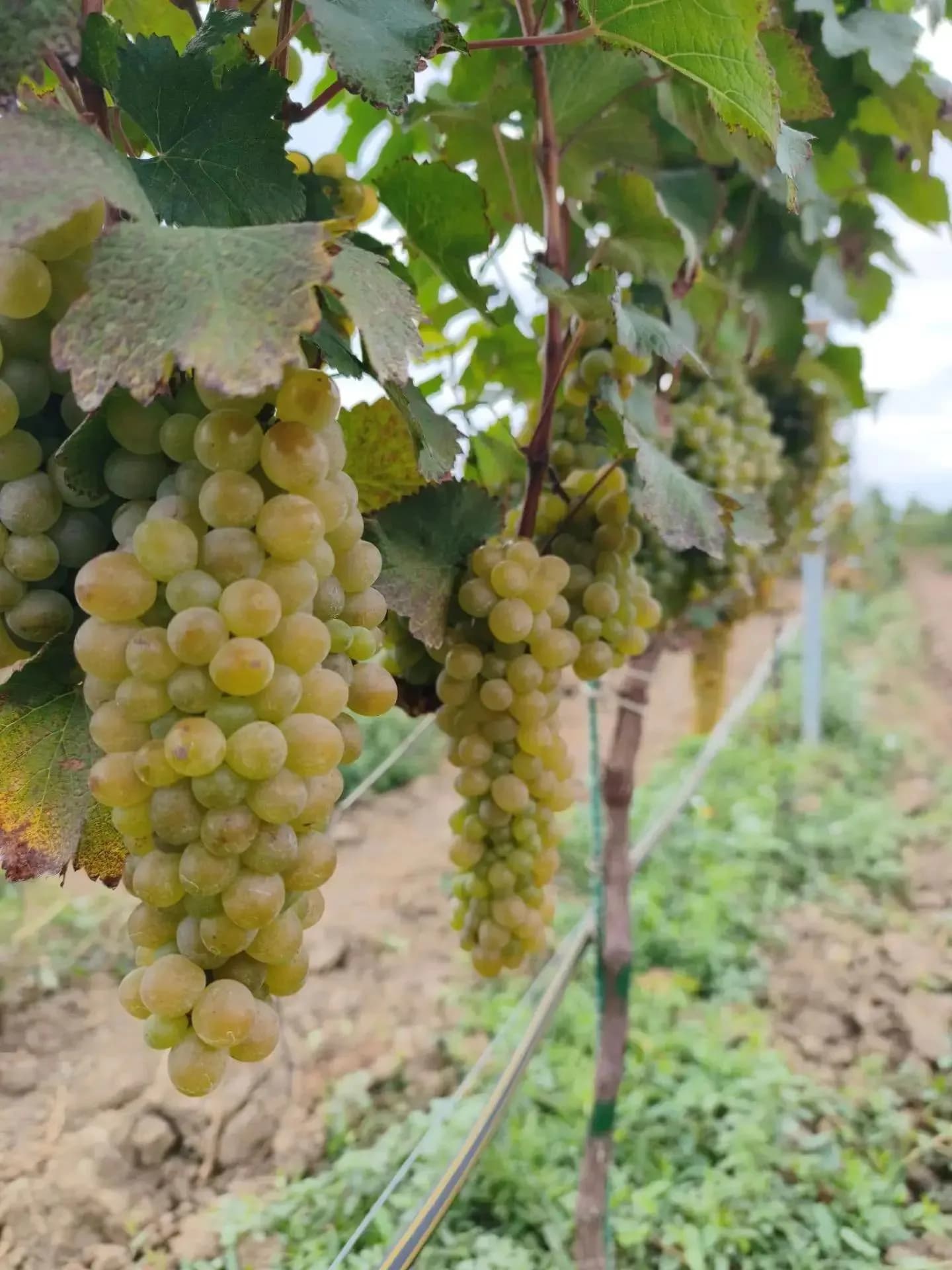
The 2026 season was a difficult one for a Rkatsiteli vineyard (own-rooted vines planted in 2022, Derbent District, Dagestan): spring flooding and waterlogging of the plot delayed recovery of the vegetative mass by two weeks compared with normal, and caused arm dieback — partial drying of the vine’s arms, which reduces yield potential.
Against this stressful background, four nutrition and pre-harvest treatment variants were compared: a control (the farm’s standard programme, unchanged), a variant with the full foliar programme (magnesium amino-chelate at flower-bud development and fruit set, calcium amino-chelate during berry growth, and a senicant combined with an ethylene inducer two weeks before harvest and again one week before), plus two intermediate variants.
The most telling result of the trial was not so much the yield increase (8.5 t/ha versus 7.1 t/ha in the control — a gain of around 20%) as the sharp reduction in berry cracking: 5% in the full-programme variant versus 21% in the control. This matters fundamentally for Rkatsiteli, where berry cracking before harvest is one of the main causes of yield loss and reduced must quality.

In the variant where pre-harvest senication was left out of the programme, cracking stayed at 17% — practically the same as the control — even though the rest of the seasonal nutrition programme matched the successful variant. This indicates that it is the two-stage pre-harvest treatment with a senicant combined with a transpiration regulator that is responsible for reducing cracking losses, rather than in-season nutrition on its own.
This material is based on data from a production trial (Derbent District, Republic of Dagestan, 2026 season).