




Modern fruit growing increasingly values not just gross yield but fruit quality. Consumer demand is shifting toward produce with strong flavour, while retailers impose strict requirements on storability and transportability. One of the key integrative indicators capturing all of these aspects is the concentration of soluble dry matter in the cell sap, measured in degrees Brix (°Bx). Managing this parameter in the final stages of the growing season through senication opens up real potential for growers to raise the profitability of perennial plantings.
Brix: not just sweetness, but quality, storability and yield
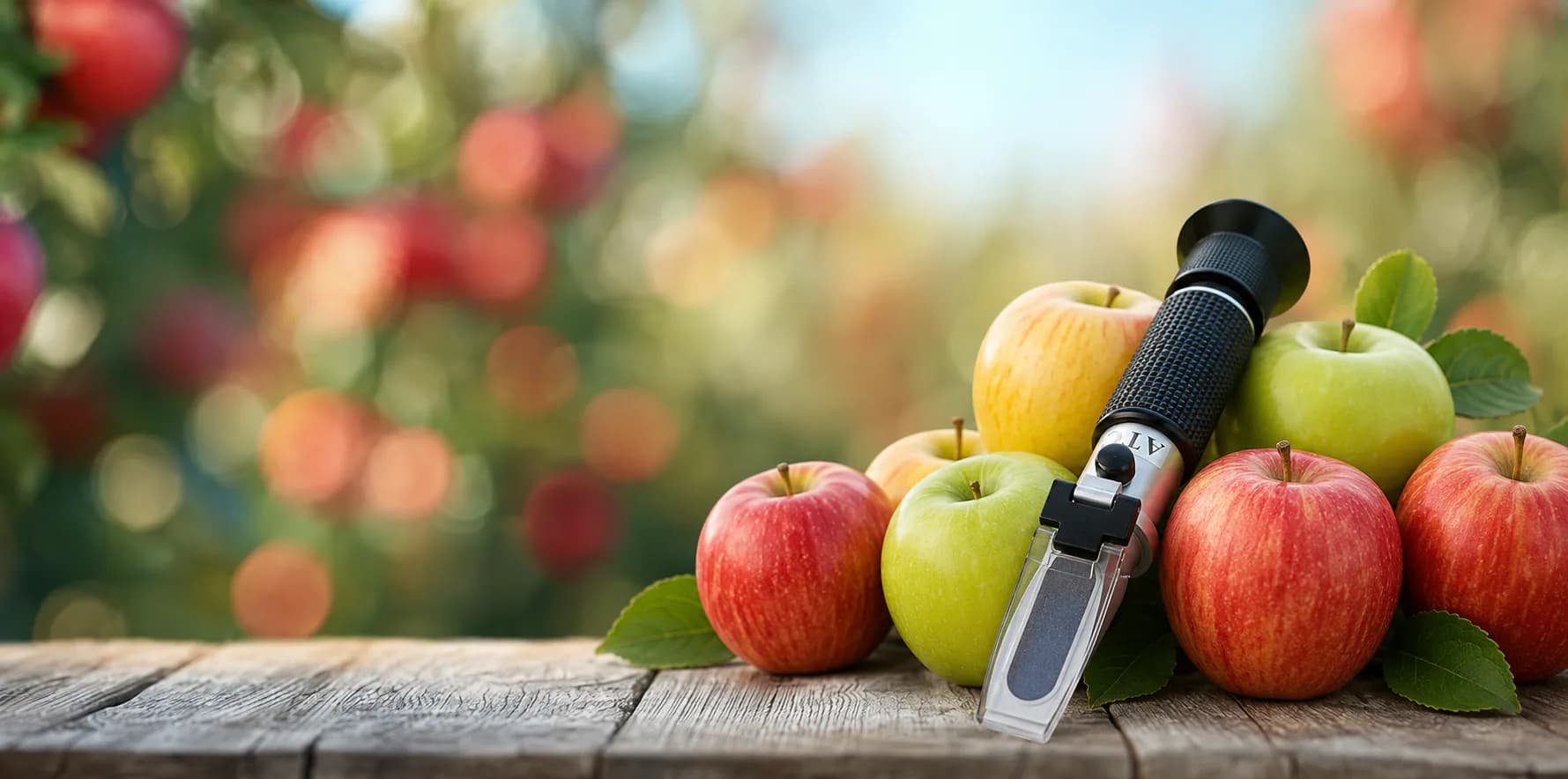
The Brix reading, measured with a refractometer, reflects the concentration of dissolved compounds in the cell sap, mostly sugars (sucrose, glucose, fructose). Its significance, however, goes far beyond a simple measure of sweetness. Brix is a reliable predictor and correlate of a whole complex of commercially important traits.
Flavour and consumer appeal. Sugar content is one of the main drivers of a fruit’s sensory profile. High Brix is directly linked to a richer, more balanced flavour — a key factor in end-consumer purchasing decisions. In global breeding and variety-trial practice for perennial crops, Brix is a mandatory evaluation criterion.
Storability and transportability. The link between high dry-matter content and the ability of fruit to store well over time is a firmly established fact. The higher the Brix reading, the heavier and more storage-stable the fruit. Several factors explain this: first, the high osmotic pressure of sugar-rich cell sap suppresses the development of pathogenic microflora; second, dense, dry-matter-rich tissue loses moisture more slowly and retains turgor longer. Table grapes with sugar content below 18% store for no more than two months, while more sugar-rich lots keep considerably better.
Yield by weight. This is where an important, if less obvious, economic dimension comes in. Higher dry-matter content in fruit means greater density and, as a result, greater weight per fruit. With the same fruit size and number per tree, a higher-Brix lot simply weighs more. Yield in tonnes per hectare therefore rises even without more or larger fruit — a direct addition to gross output achieved through better internal quality, not extensive biomass growth.
Senication as a tool for managing sugar accumulation
Senication (from the Latin senescere, “to age”) is an agronomic technique based on artificially stimulating the plant’s natural ageing processes to accelerate and intensify the outflow of plastic substances from vegetative organs (leaves and shoots) into the generative ones (fruit).
Unlike desiccation, which is essentially harsh chemical drying, senication is a physiologically subtle, controllable process. Its aim is not to halt vital activity but to redirect metabolic flows. Senication agents activate the plant’s enzyme systems responsible for hydrolysing stored polysaccharides in leaf and stem tissue into simple sugars, which are then transported through the phloem into the ripening fruit. Research shows that senication can increase the volume of photosynthate transferred from vegetative to generative tissue by 20–25% compared with natural ripening.
Foliart Senicant: purpose-built for the task
Foliart Senicant was developed specifically to implement a senication strategy on perennial crops. Its application targets:
Higher sugar content in fruit and root/tuber crops, directly reflected in Brix readings and all the quality traits linked to them.
Stimulated outflow of assimilates from the leaf canopy into fruit, ensuring maximum fill and higher fruit weight.
Faster, more synchronised ripening — particularly relevant for crops with an extended fruiting window or in regions with a short growing season.
More efficient use of the nutrients the plant has accumulated over the season.
An important feature of the product is that it contains no synthetic hormones and is not a herbicide. This ensures a mild, physiologically gentle effect with no risk of phytotoxicity or adverse consequences for perennial plantings.
Application technology and expected effect
Foliart Senicant is recommended for application in the phase preceding the onset of natural ripening, or at the first signs that ripening is being delayed. The optimal window is when fruit has already reached its typical size but has not yet begun actively accumulating sugars and pigments.
Applying the product delivers a combined effect:
A rise in Brix of several points, corresponding to a significant increase in sugar content.
Higher fruit weight from more complete cell filling with assimilates.
Improved storability and transportability from increased tissue density and dry-matter content.
Synchronised ripening within the canopy, reducing the number of harvest passes and streamlining harvest logistics.
Conclusion
Managing fruit quality in perennial crops at the final stage of the growing season is not about fixing earlier mistakes — it is an opportunity to realise the plant’s accumulated potential with maximum efficiency. Senication with Foliart Senicant redirects metabolic flows in favour of the generative organs, delivering gains in sugar content (Brix), fruit weight and storability. As the market increasingly rewards quality over quantity, this technique is becoming an important tool for raising profitability in fruit growing.
#Foliart #Senication #PerennialCrops #Horticulture #Agronomy #Fertility #Yield #Brix #FoliartSenicant