



The Molecular Physiology of Plant Stress: From Signal Perception to Gene Expression and the Synthesis of Protective Metabolites
Plant stress is not simply a state of suppression: it is a highly complex, multilevel and tightly coordinated physiological response. At the whole-plant level we see wilting, scorching or arrested growth, while at the cellular and molecular levels a genuine “biochemical drama” is unfolding. To manage crop productivity effectively under adverse conditions, an agronomist needs to understand which genes, enzymes, signalling molecules and hormones are involved. This knowledge makes it possible to move from passively observing the consequences of stress to active, science-based intervention.
Step 1: Signal Perception and Second Messengers
Every stress response is preceded by perception of the stimulus, whether it is pathogen attack, drought, heat or salinity. This process begins at the cell membrane, where specialised receptor proteins are located. They “recognise” the stress signal and set off a cascade of intracellular events.

Calcium (Ca²⁺) as a universal second messenger. One of the earliest and most universal responses of a plant cell to virtually any abiotic or biotic stress is a rapid, sharp rise in the concentration of free calcium ions in the cytosol. Ca²⁺ acts as a universal second messenger involved in the diverse cellular processes that lead to plant stress responses. The rise occurs through the opening of calcium channels in the membrane and the influx of ions from the apoplast or from intracellular stores (the vacuole and the endoplasmic reticulum).
To “decode” this calcium signal, the cell has a whole arsenal of sensor proteins. They contain dedicated calcium-binding sites (EF-hand motifs) that change conformation and become active when Ca²⁺ binds. The main calcium sensors are:
Calmodulins (CaM) and calmodulin-like proteins (CML), which activate many targets, including enzymes and transcription factors.
Calcium-dependent protein kinases (CDPK/CPK), key sensor-effectors that directly phosphorylate (activate) target proteins and pass the signal further along the chain.
Calcineurin B-like proteins (CBL), which interact with specialised kinases (CIPK) to form yet another powerful signalling system.

Reactive oxygen species (ROS) as both signal and weapon. Almost simultaneously with the calcium spike, the cell undergoes an “oxidative burst”: a sharp rise in the concentration of reactive oxygen species. These include the superoxide anion (O₂⁻), hydrogen peroxide (H₂O₂), singlet oxygen (¹O₂) and the hydroxyl radical (OH•). The main producers of ROS in a stressed cell are the membrane-bound enzymes NADPH oxidases (RBOH), which are activated, among other things, by the calcium signal.
For a long time ROS were regarded solely as toxic agents causing oxidative damage to lipids, proteins and DNA. Today, however, their essential signalling role is well established. H₂O₂ in particular plays a central role in signalling pathways, stress responses and the regulation of growth. ROS act as early signals under many abiotic stresses, modifying enzyme activity and regulating gene expression.
Gasotransmitters: NO and H₂S. The calcium and ROS signals are complemented by gaseous signalling molecules, of which the most important are nitric oxide (NO) and hydrogen sulphide (H₂S). These endogenously generated molecules can strengthen or weaken one another’s action and also interact with hormonal signalling pathways, notably that of ethylene. They take part in regulating the cell’s redox balance and control the activity of specific enzymes.
Step 2: Signal Transduction — the MAPK Cascade

The perceived signal must be amplified and relayed to the nucleus, where the genes reside. This is done by one of the most highly conserved signalling pathways in eukaryotes, the MAP kinase cascade (mitogen-activated protein kinase cascade). It is a universal signalling mechanism required for plant development, growth and stress tolerance.
The cascade is a sequence of three types of protein kinase that activate one another by phosphorylation:
MAPKKK (MAP kinase kinase kinase): the first in the chain, activated by receptors or second messengers.
MAPKK (MAP kinase kinase): phosphorylated by MAPKKK, which activates it.
MAPK (MAP kinase): the terminal kinase of the cascade, which phosphorylates many target proteins, including transcription factors in the nucleus.
Through this cascade of phosphorylation, the MAPK pathway progressively amplifies diverse stress signals and relays them to downstream response factors, triggering a series of stress responses.
Interestingly, plant genomes contain dozens or even hundreds of MAPK cascade genes. In sugarcane, for example, 89 MAPK, 24 MAPKK and 107 MAPKKK genes have been identified. This diversity allows the plant to fine-tune its response to different types of stress: some genes are activated by drought, others by salinity, and others by pathogen attack.
Step 3: Transcription Factors — the “Conductors” of the Genetic Orchestra
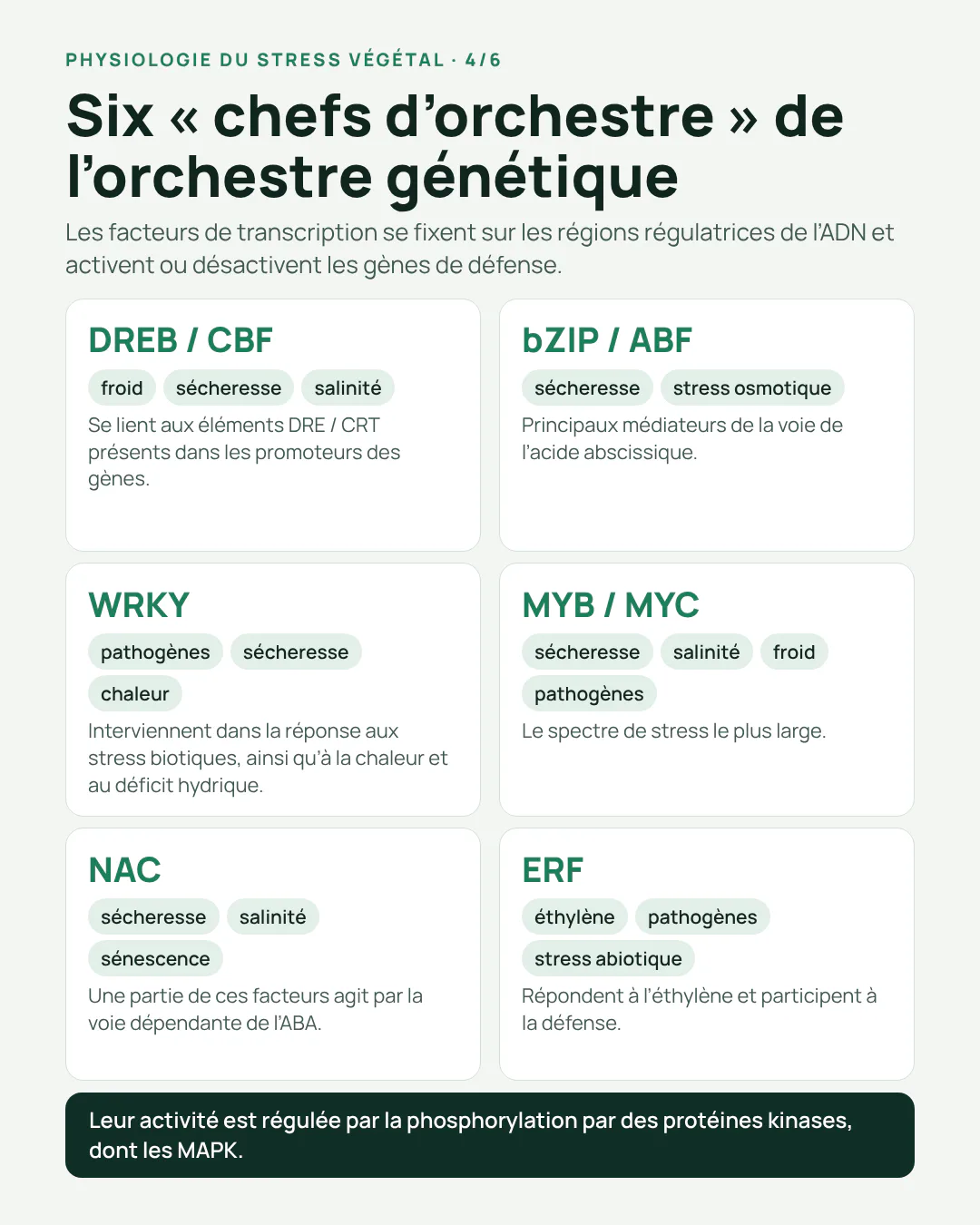
When the signal reaches the nucleus, it must switch certain genes “on” or “off”. This is the job of transcription factors (TFs): proteins that bind to regulatory regions of DNA (cis-elements) and modulate gene activity. Transcriptional regulation of stress-responsive genes is a decisive step in establishing stress tolerance mechanisms.
Six major families of transcription factors play a key role in the plant stress response: DREB/CBF, bZIP/ABF, WRKY, MYB, NAC and ERF. Extensive research has identified these TFs as stress-responsive, and they may be prime targets for crop improvement.
DREB/CBF - Key regulators of the response to cold, drought and salinity. Bind to DRE/CRT elements in gene promoters
bZIP/ABF - Main mediators of the abscisic acid (ABA) signalling pathway under drought and osmotic stress
WRKY - Involved in the response to biotic stresses (pathogens), as well as to drought and heat
MYB/MYC - Involved in the response to drought, salinity, cold and pathogen attack
NAC - Regulate the response to drought, salinity and senescence; some NAC factors act through the ABA-dependent pathway
ERF - Respond to ethylene and take part in defence against pathogens and abiotic stresses
A key mechanism regulating the activity of these transcription factors is their phosphorylation by protein kinases, including MAPKs. This is one of the principal post-translational modifications and plays a critical role in cell signalling and gene expression.
Step 4: Hormonal Regulation — a Network of Interconnected Pathways
In parallel with MAPK signalling and the activation of transcription factors, a large-scale rebalancing of hormones takes place in the stressed plant. Phytohormones act as key regulators that integrate growth and stress responses through complex signalling pathways. Importantly, different hormones do not act in isolation but form an intricate network of crosstalk, which fine-tunes the response to the specific type and severity of stress.

Abscisic acid (ABA) — the principal abiotic stress hormone. ABA synthesis rises sharply under drought, salinity and cold. It triggers stomatal closure, reducing water loss, and activates the expression of many defence genes. ABA is biosynthesised in plastids from carotenoids (violaxanthin). The key enzymes of this pathway include 9-cis-epoxycarotenoid dioxygenase (NCED), xanthoxin dehydrogenase and abscisic aldehyde oxidase.
Jasmonic acid (JA) — the hormone of wounding and defence against insects. Jasmonates are synthesised via the octadecanoid pathway from α-linolenic acid released from membrane lipids when tissue is damaged. The key enzymes are lipoxygenase (LOX), allene oxide synthase (AOS), allene oxide cyclase (AOC) and 12-oxophytodienoate reductase 3 (OPR3), together with the β-oxidation enzymes in peroxisomes.
Salicylic acid (SA) — the hormone of systemic acquired resistance. SA plays a central role in defence against biotrophic pathogens and in establishing systemic immunity. Plants synthesise SA by two independent routes: the isochorismate synthase (ICS) pathway and the phenylalanine ammonia-lyase (PAL) pathway.
Ethylene — the gaseous hormone of senescence and stress. Ethylene is produced in response to numerous stresses, and recent research has brought it to the fore as a key regulator of growth and yield under abiotic stress. Ethylene biosynthesis involves two key enzymes: ACC synthase (ACS), which converts S-adenosylmethionine into 1-aminocyclopropane-1-carboxylic acid (ACC), and ACC oxidase (ACO), which oxidises ACC to ethylene.
Step 5: Synthesis of Protective Proteins and Metabolites
The end result of transcription factor activation and hormonal rebalancing is the synthesis of a broad spectrum of protective compounds that directly ensure the survival of the cell.
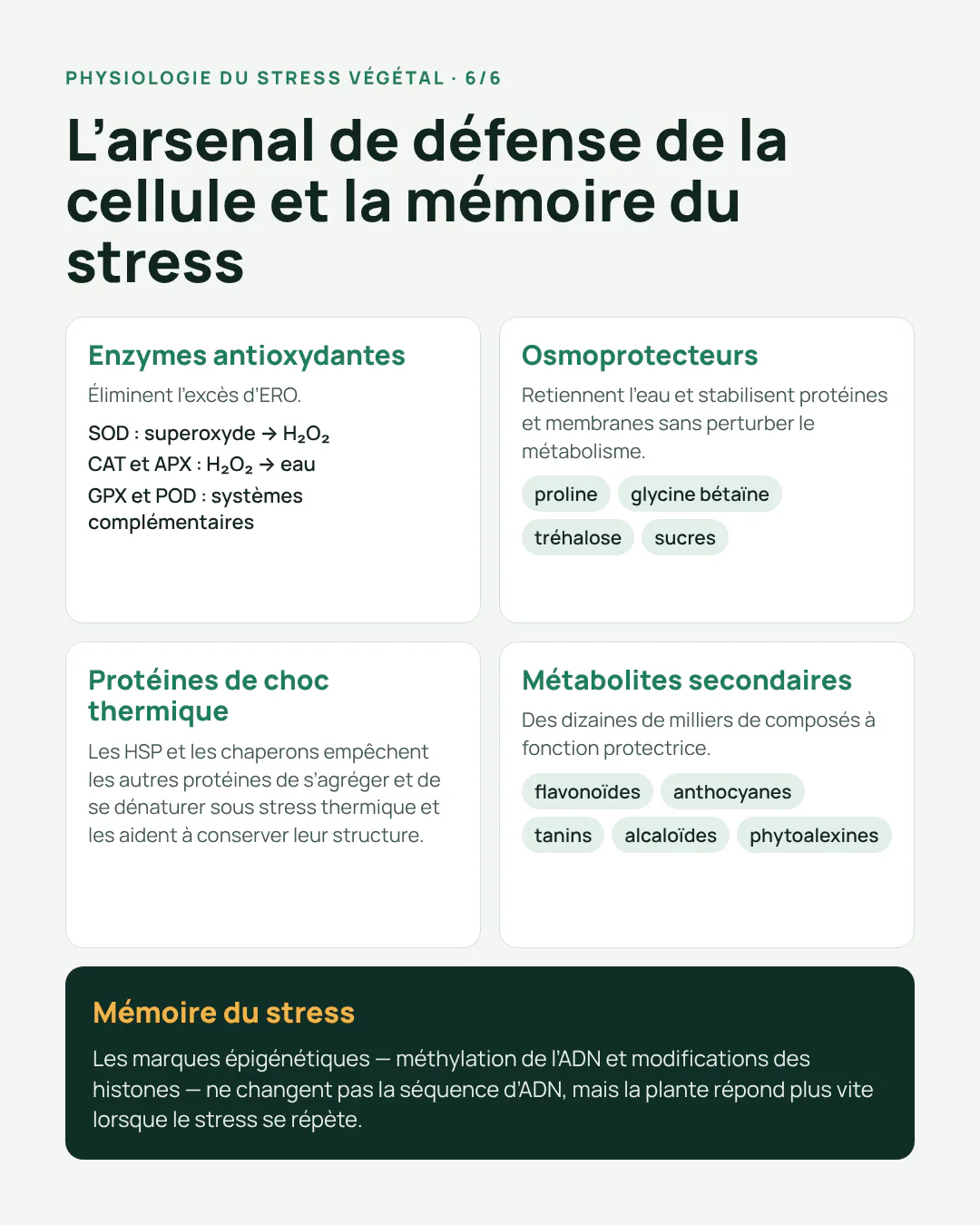
Antioxidant enzymes. To neutralise excess ROS, the cell activates a powerful antioxidant system. Its key enzymes include superoxide dismutase (SOD), which converts superoxide into hydrogen peroxide; catalase (CAT) and ascorbate peroxidase (APX), which break down H₂O₂ to water; and also glutathione peroxidase (GPX) and peroxidase (POD).
Osmoprotectants. Under osmotic stress (drought, salinity), cells accumulate low-molecular-weight organic compounds that stabilise proteins and membranes without disrupting metabolism. These include proline, glycine betaine, trehalose and soluble sugars.
Heat shock proteins (HSPs) and chaperones. Under temperature stress, the synthesis of specialised proteins is activated. They prevent other proteins from aggregating and denaturing and help them retain their native structure.
Secondary metabolites. At the cellular and subcellular level, the plant stress response involves a complex of branching processes, genetic and molecular, that lead to the formation of tens of thousands of secondary products with a protective function. These include flavonoids, anthocyanins, tannins, alkaloids and phytoalexins.
Step 6: Epigenetic Regulation and “Stress Memory”
Recent research shows that plants can “remember” a stress they have experienced and respond faster to repeated exposure. This phenomenon, known as “stress memory”, operates through epigenetic mechanisms that do not alter the DNA sequence. DNA methylation and histone modifications are the key epigenetic modifications that can influence plant development. Epigenetic regulation has the potential to revolutionise plant breeding and raise yields by regulating gene expression.
Conclusion
Plant stress physiology is not a chaotic collection of damage but a highly organised, hierarchical response system. From perception of the signal by calcium sensors and ROS, through MAP kinase cascades and the activation of transcription factors, to the synthesis of hormones and protective metabolites, every step has been finely tuned by evolution to maximise the chances of survival. Understanding these molecular mechanisms opens new horizons for modern agronomy: from the targeted use of anti-stress products to the development of varieties with improved stress tolerance.