



Maize (Zea mays L.) is a crop that originated in the tropics, with an optimal development temperature range of 22–29°C. It can tolerate brief spikes up to 44°C, but even short periods of heat — especially during critical growth stages — can cause substantial damage to productivity. Amid global climate change, marked by more frequent periods of extreme heat and soil drought, understanding the physiological mechanisms behind maize's stress response, and how to manage them, has become essential for stable grain production.
Transpiration as a cooling system — and its vulnerability
In hot, sunny weather, maize — like other plants — has to shed excess heat. Its main thermoregulation mechanism is transpiration: the evaporation of water from the leaf surface through the stomata. By evaporating moisture, maize stomata work like an efficient air-conditioning system, cooling the leaf blade by 10–15°C relative to ambient air temperature on a hot, sunny day. Without this cooling, leaf tissue would face heat-induced protein denaturation and irreversible damage to the photosynthetic apparatus.
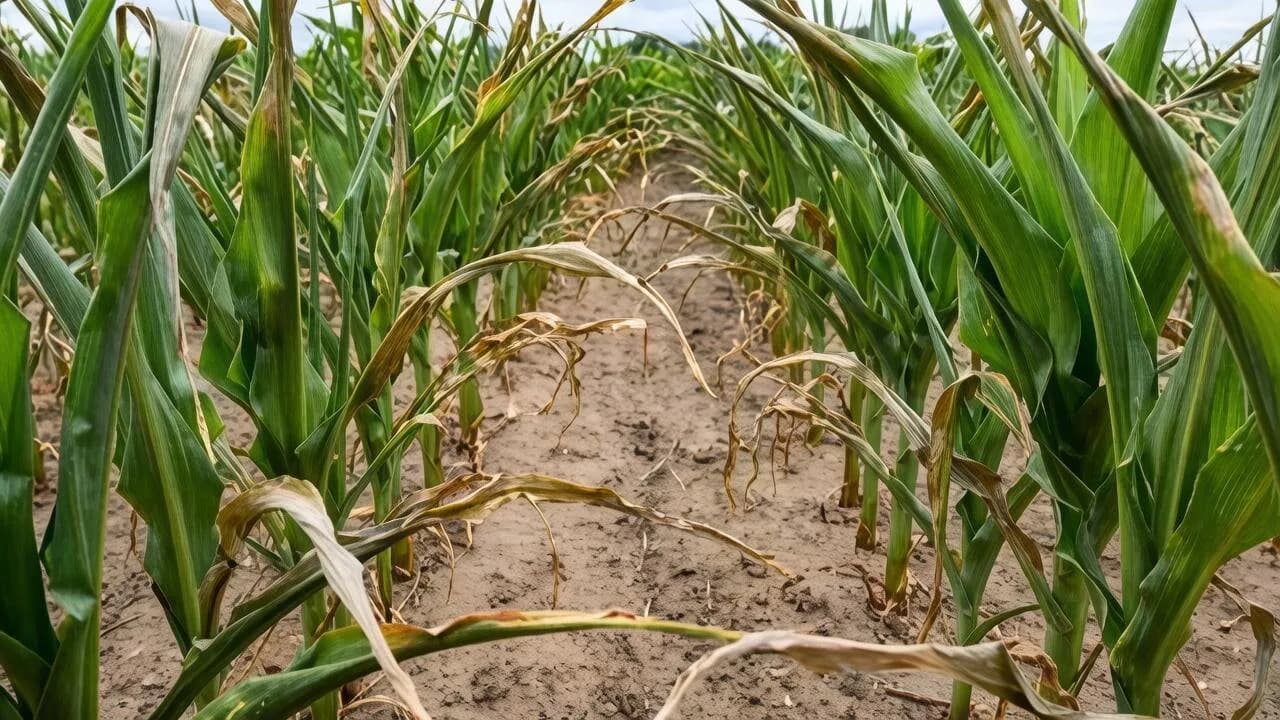
Transpirational cooling’s effectiveness, however, depends directly on soil moisture availability. As the plant grows and leaf area expands, transpiration becomes the main channel of water use, with peak evapotranspiration — up to 0.33 inches (about 8.4 mm) per day — occurring between the V16 stage and the start of grain fill (R2). When the rate of water loss through transpiration begins to exceed the root system’s ability to draw moisture from the soil, the plant enters a state of water deficit. Visually, this shows up as the classic, well-known symptom every agronomist recognises: leaf rolling.
The biophysics of rolling: the role of bulliform cells
Leaf rolling in maize is not random wilting — it is an active, evolutionarily conserved protective mechanism operating at the cellular level. Like other grasses, maize carries specialised, large, thin-walled bulliform cells in the upper leaf epidermis, arranged in groups of three to five cells running the length of the leaf blade. These cells are highly vacuolated and, critically, can change turgor very quickly.
When the rate of water loss from the leaf exceeds the water supplied by the vascular system, the bulliform cells are the first to lose turgor, contracting and shrinking in volume. Because they sit on the upper (adaxial) leaf surface, their contraction creates mechanical tension that folds the blade inward along the midrib into a tube. This lets the plant sharply reduce the leaf area exposed to sunlight, cutting transpiration and conserving precious moisture.
A double-edged adaptation: the cost of protection
While leaf rolling is an effective water-conservation mechanism, it comes at a steep physiological price. Rolling not only reduces transpiration but also restricts CO₂ supply to the chloroplasts, inevitably lowering photosynthetic rate. Research shows that when leaf rolling is artificially prevented in plants under severe drought, photosynthetic parameters decline even more sharply — confirming that rolling is an important, necessary mechanism for protecting the photosynthetic apparatus from complete degradation.
Even so, prolonged time spent in the “rolled leaf” state inevitably costs yield. Every day of vegetation in this state costs at least 1% of potential yield. If leaf-rolling stress persists for more than 12 hours a day, or continues for four or more consecutive days, grain losses become significant. During the critical window — two weeks before and two weeks after flowering — damage can reach 3–9% of yield for every day of severe stress.
Foliart Iliostop: managing transpiration instead of blocking it
Traditional agronomic drought-management tools — irrigation, mulching, selecting drought-tolerant hybrids — demand significant resources and are not always available. An alternative approach is applying antitranspirants: substances that regulate the rate of water evaporation from the leaf surface. Research shows that applying antitranspirants to maize under moisture deficit raises yield by an average of 11–17%.
Foliart Iliostop is a next-generation transpiration regulator that works as a “smart” semi-permeable membrane. Applied to the leaf surface, it forms an ultra-thin polymer film that adds diffusive resistance for water vapour while remaining permeable to carbon dioxide.
Iliostop’s key advantage for protecting maize against heat and drought is that it prevents the critical drop in leaf water potential that triggers bulliform cell contraction and subsequent leaf rolling. By optimising transpirational flow, the product allows the plant to:
keep the leaf blade unrolled and physiologically active;
sustain continuous gas exchange and photosynthesis even during peak heat hours;
avoid the sharp swings in water status that trigger xylem cavitation;
use soil moisture more efficiently.
For maize, Iliostop is recommended at 1–2 L/ha (depending on spray volume), applied preventively ahead of a forecast heat event or at the first signs of water stress. The product is compatible with most fertilisers and crop-protection products, but must not be tank-mixed with copper or sulphur products.
Conclusion
Leaf rolling in maize is a visible signal that the plant has switched into “survival mode,” sacrificing photosynthesis to preserve its water balance. Understanding the biophysics of this process — rooted in the action of the epidermal bulliform cells — lets the agronomist move beyond simply observing the stress to actively managing it. Using the transpiration regulator Foliart Iliostop keeps the leaf canopy functionally active even under extreme heat, directly translating into protected yield and grain quality.
#Maize #Drought #Heat #CropStress #Yield #Iliostop #Transpiration #Agriculture #Foliart