





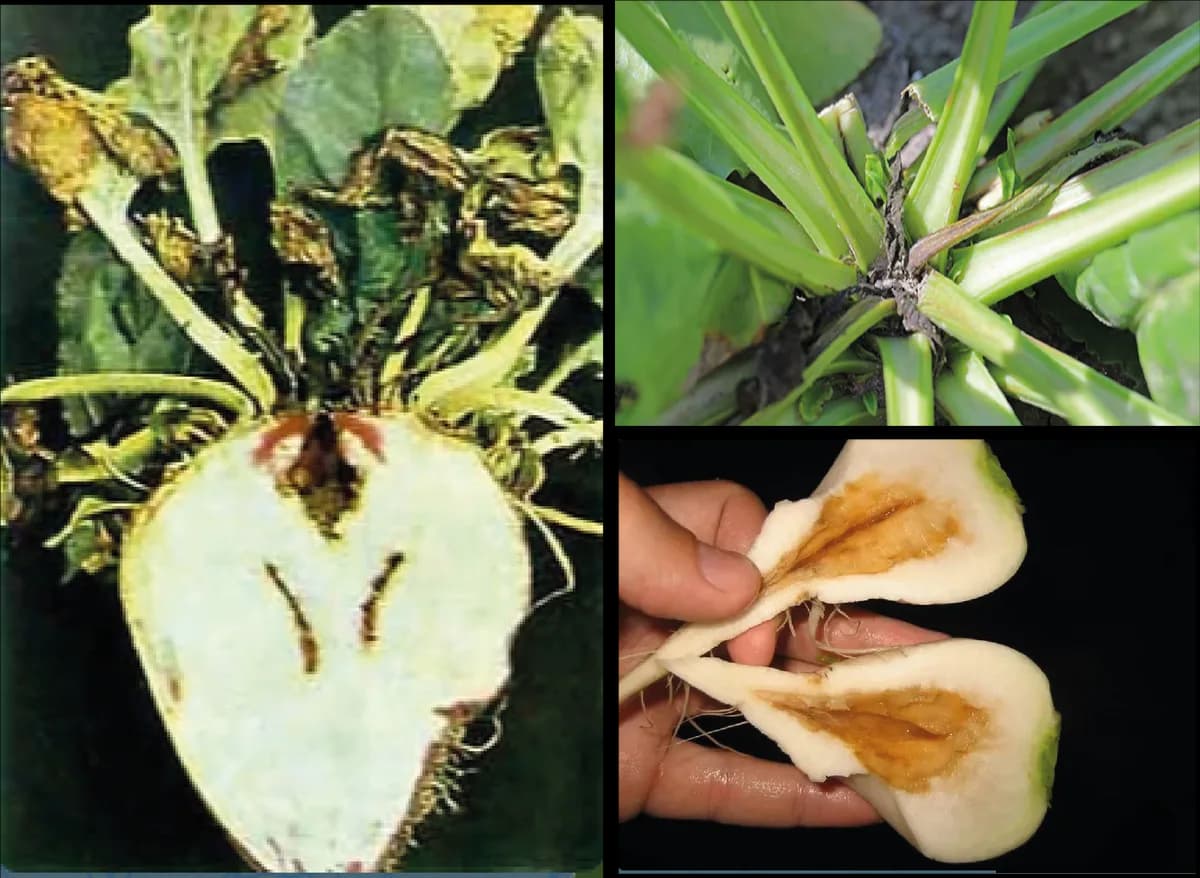
Table beet and sugar beet are among the crops most responsive to balanced mineral nutrition. A root that looks healthy and well-sized on the outside can hide internal defects that only show up when it's cut open, or during storage. Among these hidden disorders, physiological core rots hold a special place — conditions often mistaken for infectious disease. Their root cause, however, lies not in a pathogen attack, but in a deep metabolic disruption driven by a deficiency of two key elements: boron and calcium.
Boron starvation: heart rot and dry rot
Sugar beet, and table beet close behind it, are among the crops most sensitive to boron deficiency in the soil solution. This micronutrient plays an irreplaceable role in cell wall formation, phloem sugar transport and carbohydrate metabolism. Boron deficiency can arise from drought, waterlogging, or excessive nitrogen and potassium fertilisation.
Symptoms
Boron starvation in beet shows up as a characteristic physiological disorder known as “heart rot” (core rot). It develops in the second half of the growing season. The first signs are wilting and death of the youngest inner leaves of the rosette, which blacken and dry out. The disorder then progresses to the root: a cross-section reveals dark discolouration in one or more cambium rings. Affected tissue stays firm for a long time before softening and becoming vulnerable to secondary infection.
It is important to distinguish the primary physiological nature of this disorder. The absence of larvae or feeding tunnels rules out insect damage, and the dry, odourless character of the rot — which always starts from the centre — distinguishes it from typical fungal disease.
Biochemical mechanism
Boron maintains cell wall strength and sugar transport. Under boron deficiency, the vascular system malfunctions, and sugars synthesised in the leaves cannot flow efficiently into the storage root. Facing carbohydrate starvation in its storage tissue, the plant is effectively forced to sacrifice the root core, whose tissues gradually die off. The resulting cavities are eventually colonised by secondary infection, most often the fungus Phoma betae, which causes phoma rot.
Boron deficiency is most likely on alkaline, calcium-rich soils, in years with a wet spring followed by a dry, hot summer. Heavy rainfall can also leach mobile boron out of the root zone. Studies show that on soils with pH above 6.5, a two-application foliar boron programme is essentially mandatory.
Calcium deficiency: weakened tissue and lost storability
While boron deficiency causes the root’s internal tissue to die, calcium deficiency sets the stage for damage to the outer tissue and the development of wet rots in storage.
Physiological role. Calcium is an essential component of the middle lamella of cell walls (as calcium pectate). It provides mechanical tissue strength and regulates membrane permeability. Under deficiency, plants — and the root system in particular — weaken sharply, leaves become mottled, and interveinal areas pale.
Consequences of deficiency. Calcium is a poorly mobile element in the plant, transported mainly via the xylem with the transpiration stream. Young, actively growing root tissue frequently experiences localised calcium deficiency even when soil calcium levels are adequate, because transpiration through the root’s surface is minimal. This produces tissue with weakened cell walls, easily macerated (softened) by the pectolytic enzymes of pathogenic microorganisms.
Indirectly, calcium deficiency compounds the boron problem: on alkaline soils rich in calcium carbonates, boron availability drops sharply because of the formation of poorly soluble calcium borates. Paradoxically, then, excess calcium in the soil can drive boron deficiency in the plant.
Prevention and correction: a systematic approach
Preventing physiological beet rots requires a comprehensive strategy: pre-sowing seed treatment, foliar feeding at critical growth stages, and optimised soil conditions.
Pre-sowing seed treatment with boron. The most reliable way to prevent boron starvation is targeted delivery of the micronutrient directly to the germinating root. The optimal ratio is 0.2 g of boric acid powder per 10 g of beet seed. The seed is placed in a dry container, the measured amount of boric acid is added, and the mix is shaken thoroughly until a thin whitish coating forms. This local boron reserve meets the plant’s needs throughout the season.
Foliar boron feeding. On soils with pH above 6.5, a two-application foliar programme with boron-containing products (such as Foliart Bor Amino) is recommended. The first application is made at the 4–6 true-leaf stage, the second 2–3 weeks later. Foliar boron is the most effective route, since it corrects the deficiency quickly while bypassing the problem of low soil availability.
Correcting calcium nutrition. Calcium nitrate applications during the active root-growth period address calcium deficiency. In drip-irrigated systems, water-soluble calcium forms (calcium chloride or calcium nitrate) delivered directly to the rhizosphere are effective.
Agronomic practices. Maintaining optimal soil moisture throughout the season is important. Irrigation is stopped 20–25 days before harvest, which promotes dry-matter accumulation and improves root storability.
Conclusion
Beet root rots, manifesting as “heart rot” and dry rot, are a textbook example of physiological disorders induced by micronutrient deficiency. Understanding the biochemical mechanisms linking boron and calcium shortfalls to disruption of root tissue structure and metabolism lets the agronomist move from passively watching storage losses accumulate to actively managing crop quality. Timely pre-sowing seed treatment and foliar feeding at critical growth stages are economically justified, highly effective prevention tools.
#Beet #SugarBeet #Boron #Calcium #MineralNutrition #Agronomy #BoronDeficiency #HeartRot #RootRot #Agriculture #Agrochemistry #Yield #PlantDiseasePrevention #FoliartBorAmino